In this guest post sculptor Kate Montagne writes about how she learnt clay modelling – what it is, how it is done, and some of the key characteristics of beautifully modelled ornament.
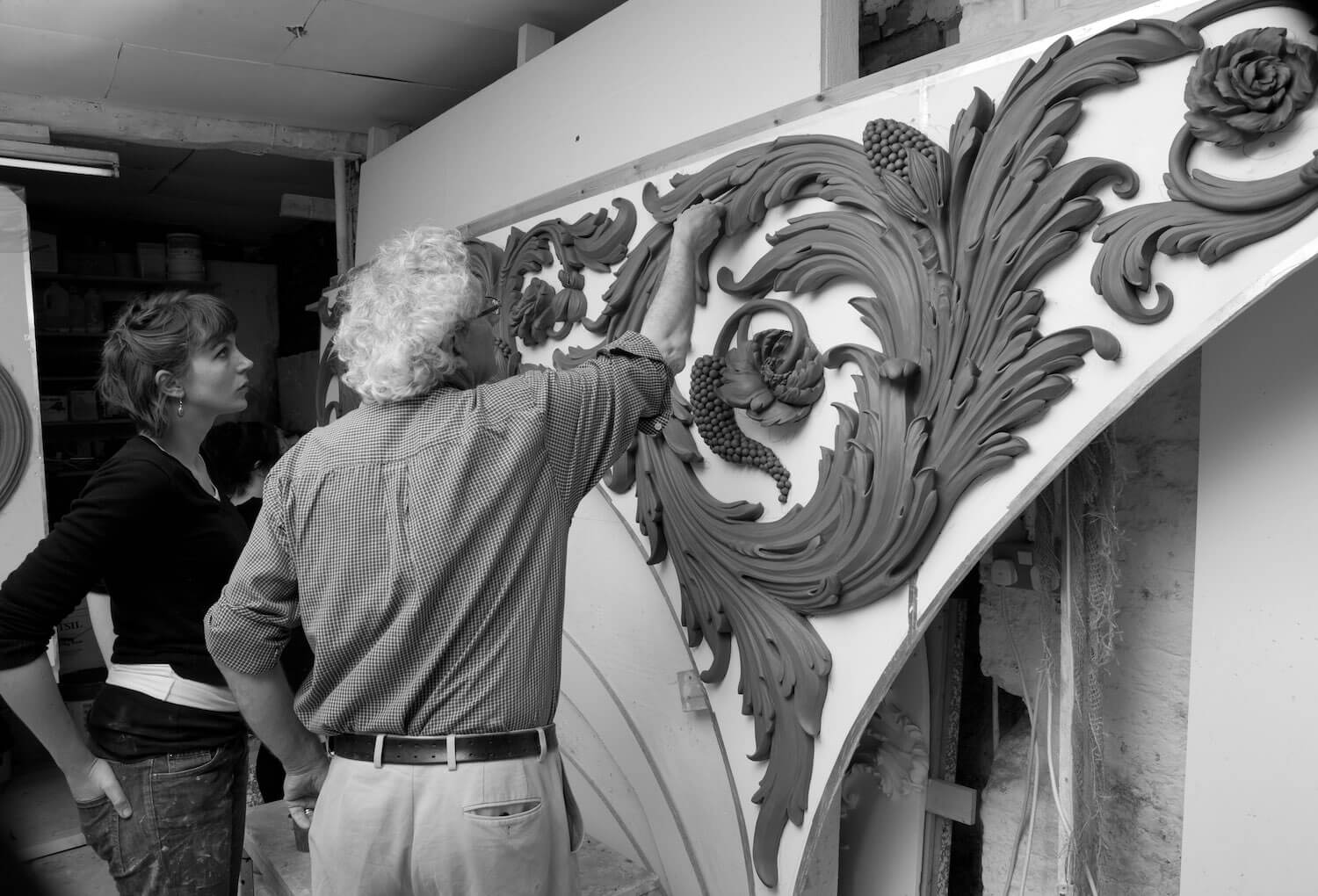
My first ever task on my first ever day in Geoffrey Preston’s workshop was to sit and watch Geoffrey model a leaf in clay. It was 2010, I was 22 and I don’t think I appreciated at the time what a special thing I was seeing – one of the country’s best clay modellers in action.
Making an ornamental plaster ceiling is a complicated business. There are many stages involved, from designing and setting out to moulding and casting, but clay modelling sits at the heart of the job, the most artful process and the most challenging to learn. My second task on that first day was to recreate Geoffrey’s leaf myself and my first inescapable impression was that clay modelling is HARD. The concentration required is intense. Those graceful organic forms look as if they sprout effortlessly out of the clay but I felt I was having to wrestle the material into shape and my first few hours work left me exhausted. As well as being difficult, clay modelling is seriously time-consuming. I am much faster now, but in those early days sculpting a single leaf could take me most of a day. Having previously worked in the time-pressed worlds of theatre and film art departments, being told to take my time and make something to the absolute best of my abilities felt remarkable.
In the 15 years since then I have been lucky enough to practise clay modelling, working under Geoffrey’s direction first as an apprentice and then an employee. As far as I know this skill is not taught anywhere in the UK, so for anyone interested I would like to share here a little of what I’ve been taught, and what I am still learning through watching an artist at work.
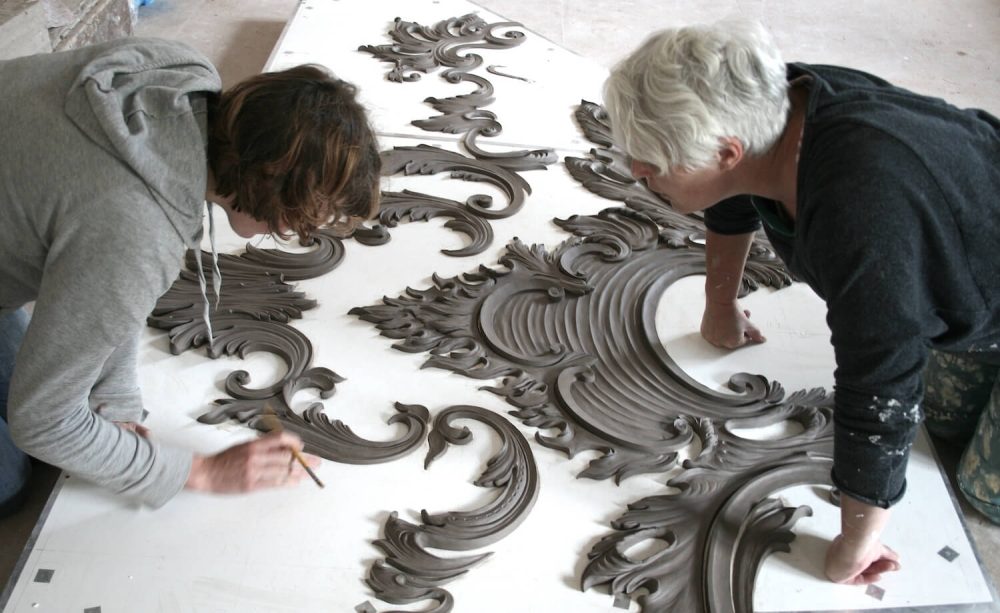
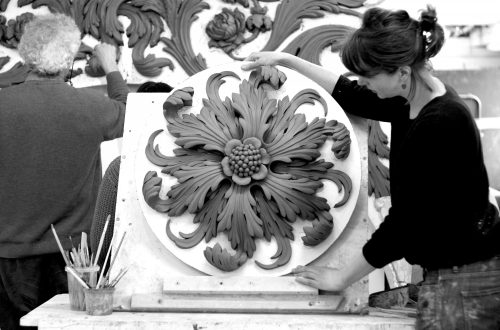
Kate Montagne and Louisa Shorney putting the finishing touches to a clay model for a new ceiling
When they see a finished clay relief many people assume it has been carved back, but in fact the process begins with an outline transferred onto a flat screed of clay. Occasionally we model onto melamine boards but a clay base allows the sculptor to draw into the background, giving extra depth and emphasis where needed. What follows is what we call ‘roughing out’, establishing the heights and weights of the different elements of the design whilst maintaining a looseness, a little like sketching but in three dimensions. Translating a two dimensional design to a three dimensional model is something that Geoffrey can do with formidable speed but for a less experienced modeller it is useful to have a good reference drawing and to set it up at the same eye-line as the piece you are working on. As you build up each element, adding clay with a wooden tool or even fingers at first, keep stepping back to judge whether you are creating shadows in the right places as it is this interplay of light and shadow that will create the visual impression. Try to make each addition thoughtful and considered, a decision about what will bring more life to the modelling. Keep looking back and forth between your reference and your model, using callipers and depth gauges to check you are reproducing correctly.
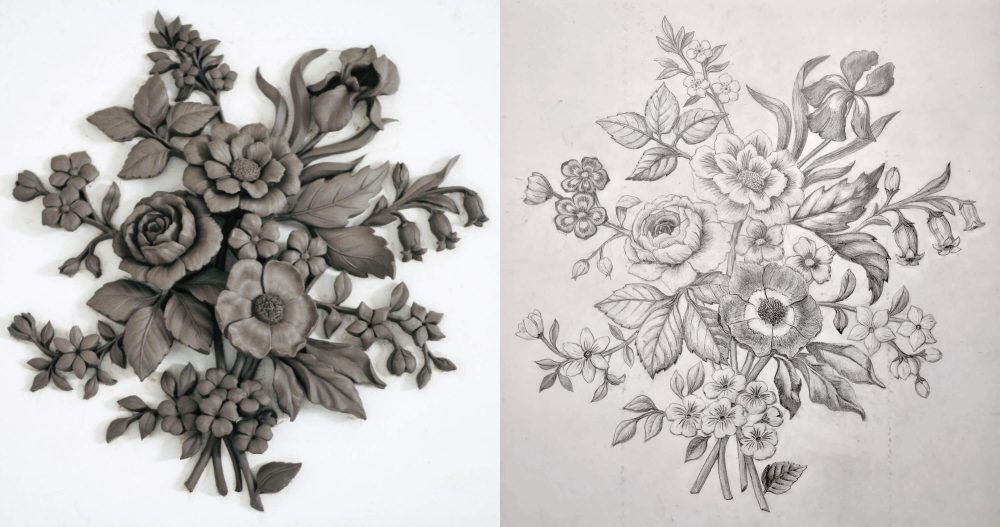
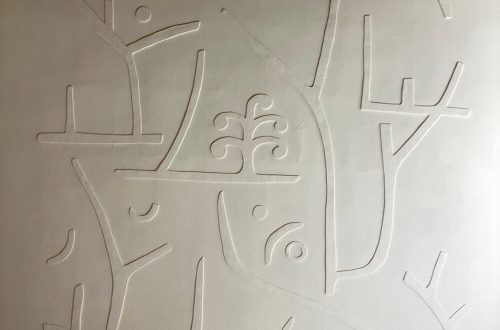
Kate’s apprentice piece – the clay model and the preparatory drawing
In contrast to wood, stone or stucco, clay is a very forgiving medium. Spraying with water and covering with clingfilm can keep a model workable for weeks, allowing the sculptor to tweak and adjust the forms as they emerge in relation to each other. As a beginner it is easy to get distracted by the surface of a model before the form is properly established. There’s a psychological element at play here. When you have worked hard to ‘finish’ a section of modelling you can be subconsciously unwilling to alter it. It is important to take regular breaks and to shift your attention between the different areas of your composition. Returning with fresh eyes can make it much easier to see what changes need to be made.
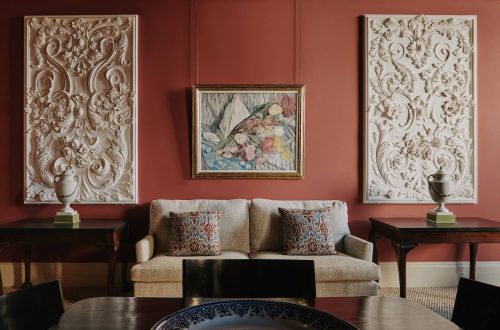
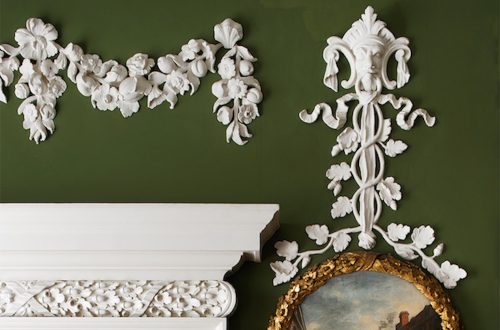
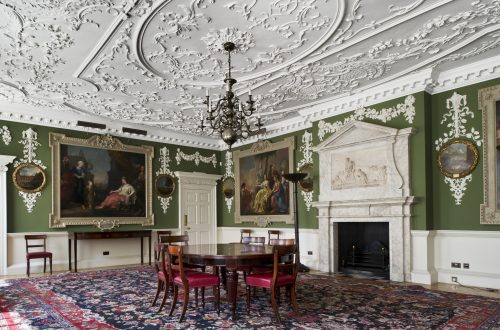
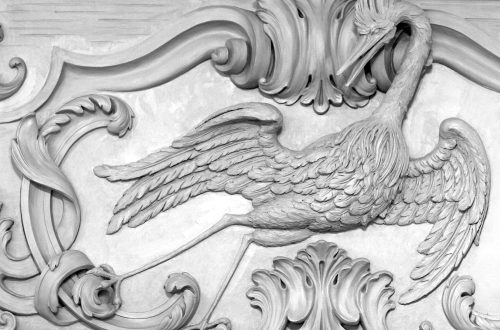
In my time as part of Geoffrey’s team we have created work in a whole range of styles, from the formal Adam style of the late 18thcentury to the more rustic Art and Crafts, but what I think of as Geoffrey’s distinctive style builds upon the energetic rococo of stuccodores such as the Artari. You can see many of the characteristic features here – rhythm, asymmetry and complexity, with elements intertwining and spilling over borders.
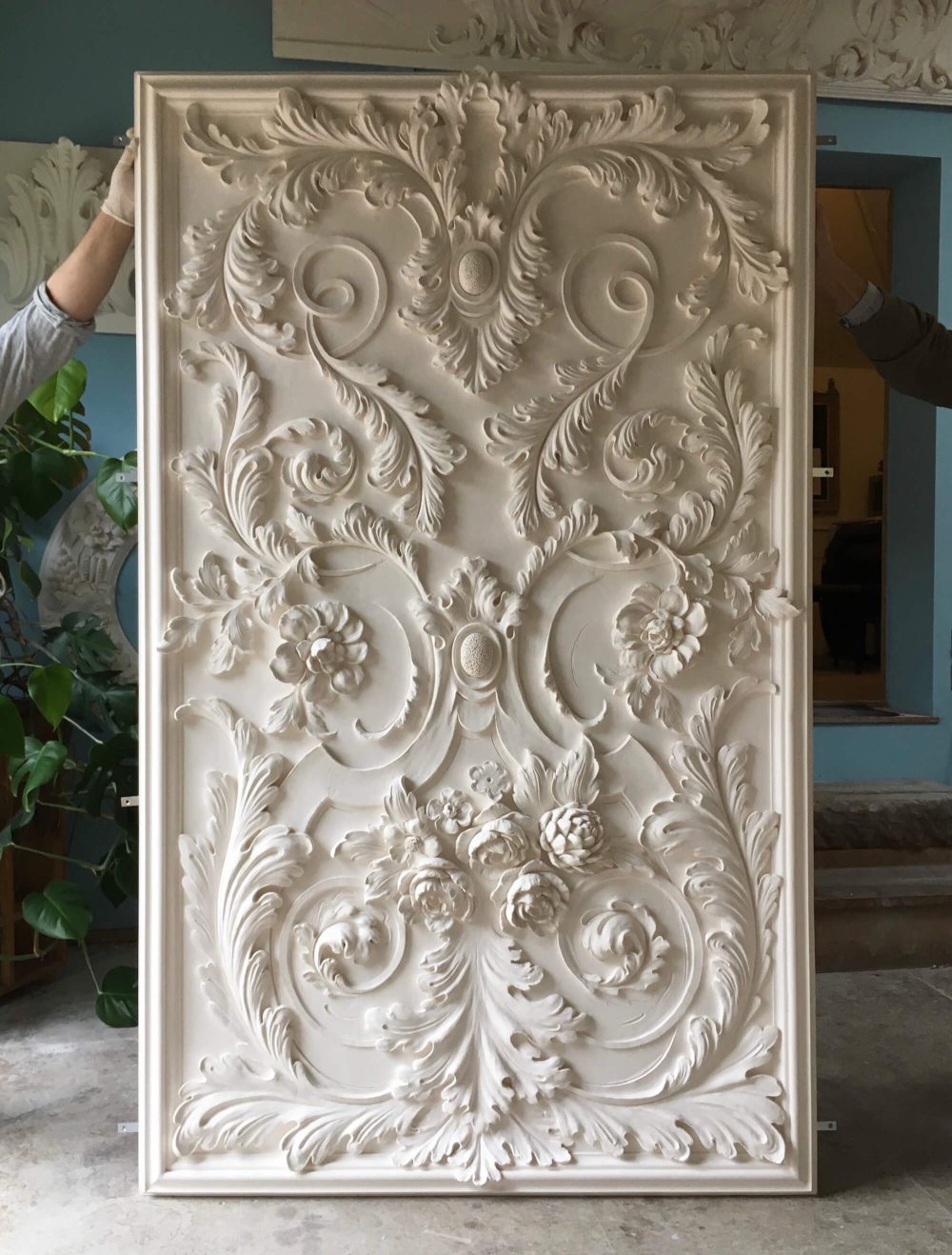
Flower Garden – one of two panels with swirling acanthus leaves and flowers
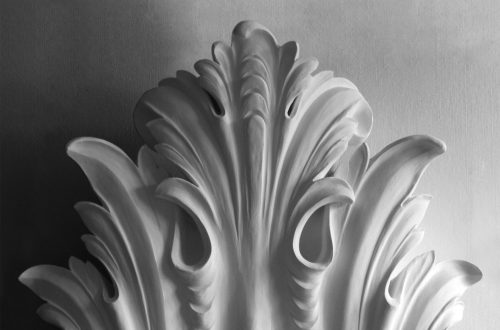
This style of modelling has its own vocabulary of forms – scrolls and leaves, flowers and flames, swags and ribbons. All of them are characterised by a sense of movement and graceful flowing curves. Geoffrey often uses a wet brush to create these flowing shapes although this technique takes practice as too much water can reduce the clay to a blobby mess. An acanthus leaf such as the one below has its own architecture of C curves and S curves, with major leaves flanked by minor leaves, and a harmonious balance between fullness and hollowness, sharp edges and softer edges. Of course all rules are made to be broken and subtle touches such as the twist of a leaf tip can bring a whole composition to life.
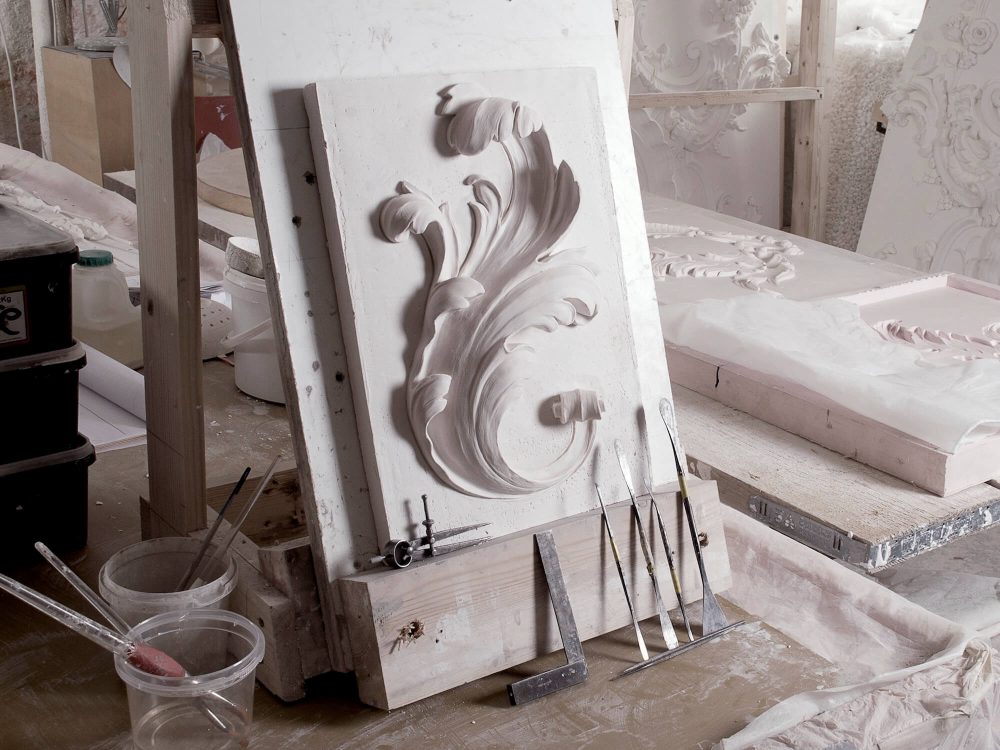
Raffle Leaf II (photo Mark Girvan)
Once everything is positioned to your satisfaction the model can be finished. This involves filling any scrappy holes and using a brush to tidy undercuts and remove unwanted tool marks. A delicate touch is needed at this stage as the level of finish can dramatically alter the feeling of a piece and it is easy to take things too far, making forms too smooth and regular and removing their vitality. When the model is finished it can be moulded and cast.
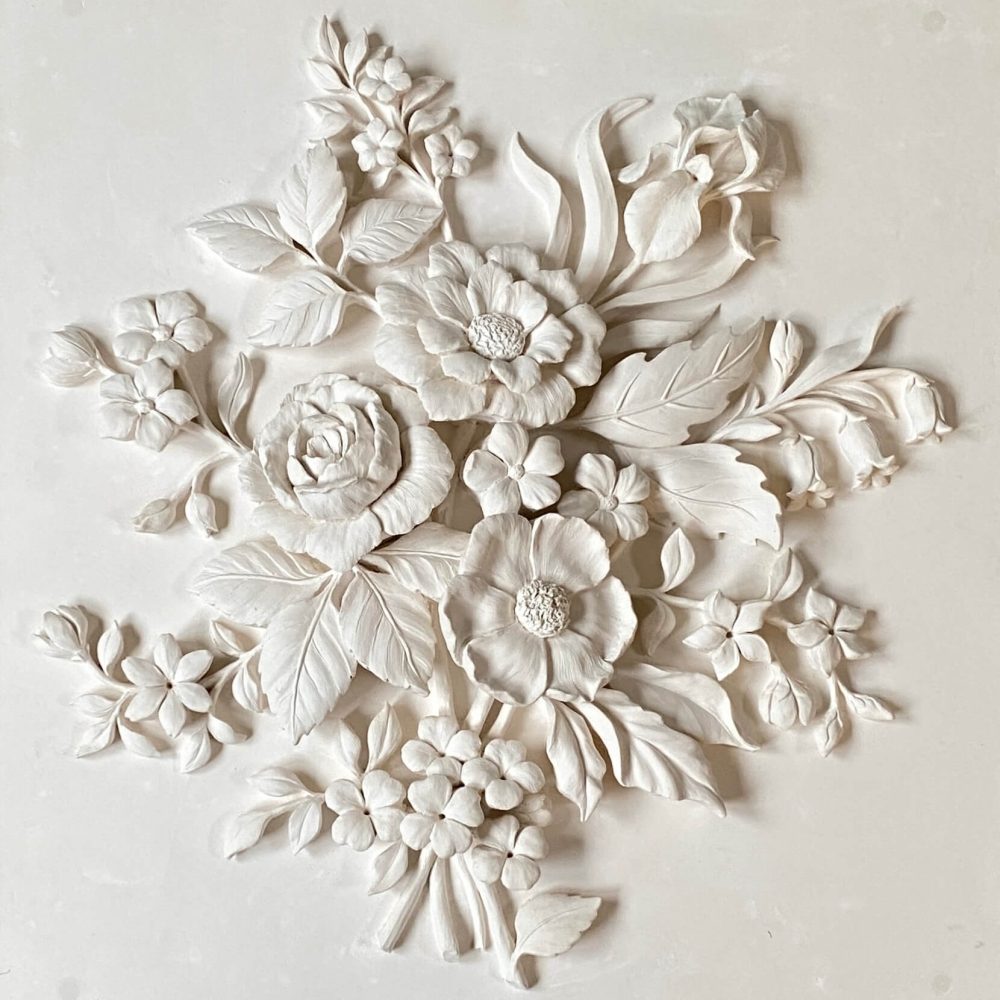
Kate’s apprentice piece – the finished cast
Perhaps because gypsum is an inexpensive material, easily reproduced through casting, ornamental plasterwork is not generally thought of as sculpture in its own right. But at its finest that is absolutely what it is. Hand-modelled plaster decorations have survived for hundreds and even thousands of years, and they are vivid expressions of the skill and sensitivity of those who made them. It is a privilege to continue in this tradition, making work with care and integrity which will hopefully be enjoyed by many generations to come.
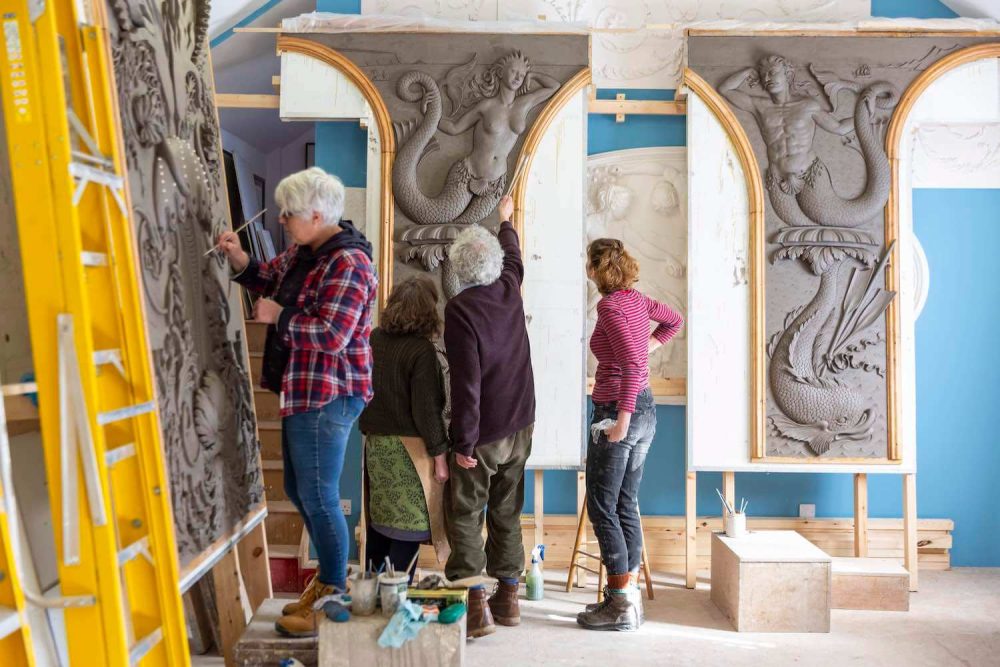
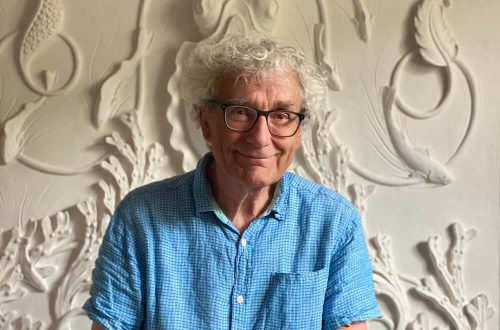
Geoffrey, Kate, Jenny and Louisa at work on a commission for The Goring hotel in Belgravia (photo Kasia Fiszer)